
Rotation and Revolution of Earth Class 9 ICSE Notes
"Rotation is the turning around of the earth on its axis from west to east."
Rotation causes all parts of Earth's surface except the poles to move in a circle around Earth's axis. Although the speed of rotation varies from place to place, it is constant at any given place. This is the reason that we experience no sense of motion. Often one can get the same impression in a modern jetliner, where a smooth flight at cruising speed is much like sitting in a comfortable living room. Only during takeoff and landing is the sense of motion quite apparent.
Effects of Earth's Rotation
1. East-West movement : Since the earth rotates from west to east, we see the sun rising in the east and setting in the west.
1. East-West movement : Since the earth rotates from west to east, we see the sun rising in the east and setting in the west.
2. Day and Night : The most important effect of earthly rotation is the diurnal (daily) alternation of light and darkness, as portions of Earth's surface are turned first toward and then away from the Sun. This variation in exposure to sunlight greatly influences local temperature, humidity, and wind movements.
3. Circulation of air and water : The earth's rotation causes a consistent change in the direction of the flow of winds and water of the oceans. Winds and ocean currents are deflected towards the right in the Northern Hemisphere and towards the left in the Southern Hemisphere. This is known as coriolis effect.
•Revolutiom and its Effects
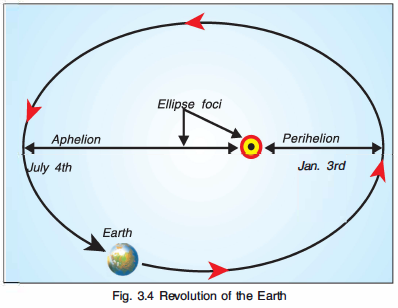
The movement of the earth around the sun is called the revolution. Earth revolves around the sun at a fixed path known as the orbit of the earth. The orbit is in elliptical in shape. Due to elliptical orbit the distance of the Earth from the Sun changes constantly during its revolution.
Important features of the revolution :
- The earth revolves round the sun west to east and it takes 365 days and 6 hours.
- The earth revolves round the sun at an average speed of 29 .8 km/sec or 107.2000 km/h.
- The earth's orbit round the sun covers a distance of about 965 million km.
- The period taken by the Earth to complete one revolution round the Sun is called a year.
During the revolution the earth follows a fixed route or path known as the orbit of the earth.
Effect of Revolution :
(i) The earth completes one revolution in 365 days and 6 hours. For our convenience, we consider the year as consisting of only 365 days and ignore the 6 hours. This time of 6 hours is added up to one day every four years and the fourth year is called a leap year. In the leap year this additional day is added in the month of February. February usually has 28 days but this month has 29 days in a leap year. The year 2000 was a leap year. Can you tell which leap year will follow 2012 ? It will be 2016.
(i) The earth completes one revolution in 365 days and 6 hours. For our convenience, we consider the year as consisting of only 365 days and ignore the 6 hours. This time of 6 hours is added up to one day every four years and the fourth year is called a leap year. In the leap year this additional day is added in the month of February. February usually has 28 days but this month has 29 days in a leap year. The year 2000 was a leap year. Can you tell which leap year will follow 2012 ? It will be 2016.
(ii) Revolution causes changes in time over different places on earth.
(iii) The cycle of seasons is the combined effect of the revolution of the Earth and the orientation or tilt of its axis.
•Effects of the tilted axis on Day and Night
The axis of the earth is tilted at an angle of 66½0. Thus the axis of the earth in its orbit around the sun remains tilted to one side. Due
to this inclination in one direction, the northern hemisphere remains inclined towards the sun during six months every year. Thus a larger part of the northern hemisphere faces the sun during this period. Every point in this part of the earth remains lighted for a longer time. Hence the days in this part are longer. In contrast the southern hemisphere is away from the sun. Therefore, the days in the southern hemisphere are shorter. During the following six months the southern hemisphere is inclined towards the sun so the days in this hemisphere are longer. At this time the northern hemisphere has shorter days.
•The Changing Seasons
The phenomenon of change of season is caused due to two reasons :
(i) The revolution of the earth around the sun.
(ii) The inclination of the earth's axis at an angle of 66½0 to the plane of its orbit. The phenomenon of changing seasons can be understood with the help of four positions of the earth during its revolution around the sun.
To understand the phenomenon of changing season we should study the movement of the earth around the sun.
•A Solstices and Equinox
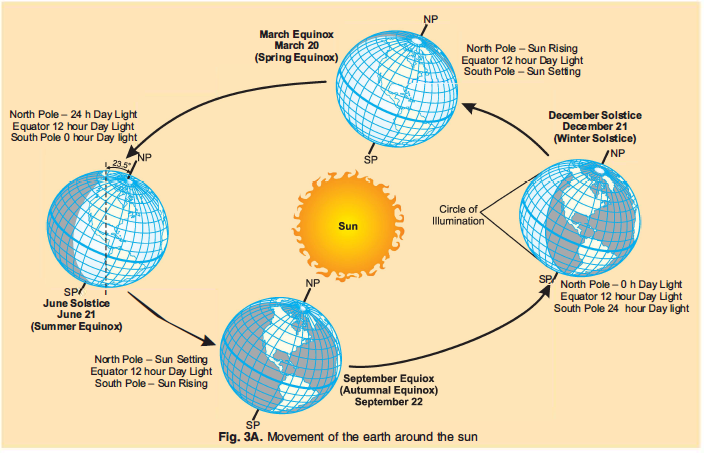
Both solstice and equinox refer to the seasons in a calendar year. These seasons come about because of the Earth's position in relation to the Sun; therefore, solstice and equinox happen four times a year. Solstices occur during winter and summer around December 21 and June 21 while equinox occurs during spring and fall around March 21 and September 22.
. The terms refer to
the Earth's axis in relation to the Sun. There are a few notable differences between solstice and equinox.
Solstice occurs when the point of the Earth's axis is pointed directly toward or away from the Sun. When this happens, the Sun appears have reached it southernmost or nothernmost points, or poles. During the summer solstice, usually the first day of summer, the Sun is farthest north and the time between sunrise and sunset is the longest. Summer solstice is said to be the longest day of the year. On the other hand, winter solstice, usually the first day of winter, the Sun is farthest south and the length of time between sunrise and sunset is shorter, leaving fewer hours of sunlight on this particular day.
•June 21st
(i) On or about June 21st the noon rays from the sun fall vertically on the Tropic of Cancer. This is because the North Pole is titled toward the sun.
(ii) The Northern Hemisphere has the longest day and shortest night.
(iii) As earth rotate its axis, all point lying of North of 66.5°N remain continously within the circle of illumination, thus experiencing 24 continuous hours of daylight-the midnight sun.
iv) On the other hand all the points 66.5° S are outside the circle of illumination and thus have 24 continuous hours of darkness .
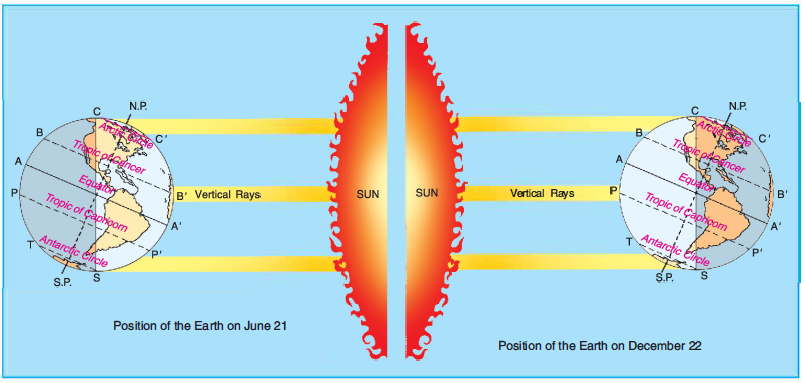
(v) It is summer in the Northern Hemisphere whereas winter in the Southern Hemisphere as during this period the Southern Hemisphere is tilted away from direct rays of sun light, thereby creating a lower angle for the incoming solar rays and thus a more diffuse pattern of insolation.
DECEMBER 22nd
(i) On or about December 22nd the rays of the sun fall vertically on the Tropic of Capricorn i.e. the parallel of 23.5°S. This is because of the South Pole is inclined towards the Sun and the North Pole is away from it.
(i) On or about December 22nd the rays of the sun fall vertically on the Tropic of Capricorn i.e. the parallel of 23.5°S. This is because of the South Pole is inclined towards the Sun and the North Pole is away from it.
(ii) The days are longer and the nights are shorter in the Southern Hemisphere.
(iii) As Earth rotates on its axis, all points lying South of 66.5°S remain continously within the circle of illumination, thus experiencing 24 hours of daylight.
(iv) By contrast, all points North of 66.5 °N are always outside the circle of illumination, thus have 24 continous hours of darkness.
(v) During this period the Northern Hemisphere is titled away from the direct rays of Sun light, thereby creating a lower angle for the incoming solar rays and thus a more diffuse pattern of insolation. Due to above phenomenon there is winter in Northern hemisphere and summer in Southern Hemisphere.
MARCH 21st
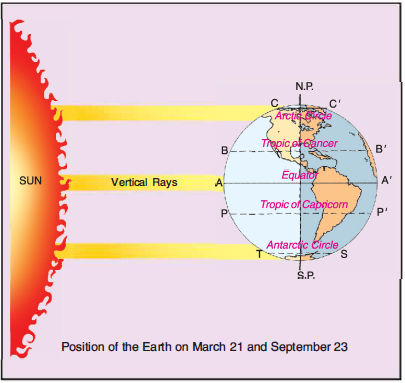
(i) The moment of the Vernal equinox or March equinox occurs on March 20 or 21.
(i) The moment of the Vernal equinox or March equinox occurs on March 20 or 21.
(ii) The rays of Sun fall vertically at the Equator.
(iii) At that time, the circle of illumination passes through both poles. So period of daylight and darkness are nearly 12 hours each all over the world.
(iv) It is spring in the Northern Hemisphere and autumn in the Southern Hemisphere. This position is known as spring equinox.
SEPTEMBER 23rd
(i) September 22nd/23rd is the moment in time of the autumnal equinox, or September equinox, when circle of illumination again passes through both poles.
(i) September 22nd/23rd is the moment in time of the autumnal equinox, or September equinox, when circle of illumination again passes through both poles.
(ii) The rays of the sun falls vertically at Equator
(iii) All parts of the globe experiences nearly a 12 hour day and 12 hour night.
(iv) It is autumn in the Northern Hemisphere and spring in the Southern Hemisphere.

0 Comments